Wednesday, February 1, 2012

Ghana hosts confab on reshaping agricultural research in Africa

Alliance for a Green Revolution in Africa
Dar es Salaam, Tanzania - UK parliamentarians and civil servants will this week join African farmers, international donors and scientists in a policy dialogue that aims to reshape agricultural research to serve development goals and the public good.

The UN Special Rapporteur on the Right to Food, Olivier de Schutter, and the executive director of Oxfam-Novib, Farah Karimi, will chair the event, which the International Institute for Environment and Development (IIED) is organising from 1-3 February in Ghana.

In a statement Monday, IIED said UK-based parliamentarians, the media and members of the international development community would participate through a live video link hosted by the All-Party Parliamentary Group of Agroecology in Westminster.

Baroness Miller, the Group’s co-chair said: “This is a unique event in that it will allow farmers from across West Africa direct access to the organisations which direct and fund research into the development of agriculture.

“We very much hope it will be productive and change the way in which research priorities are decided and implemented so that farmers become directly involved in the governance of agricultural research and development which affects them”.

Meanwhile, IIED Director Camilla Toulmin, said: “This is a valuable platform for smallholder farmers to get their voices heard. We’d like to see this constructive dialogue setting an agenda for future research priorities across the region.”

The meeting will bring staff from the Alliance for a Green Revolution in Africa (AGRA) together with small-scale farmers and food processors from Benin, Burkina Faso, Mali, Niger and Senegal, as well as from East Africa, Asia and Latin America.

With a total budget of nearly US$ 400 million, AGRA is a major funder of agricultural research in Africa. The meeting will allow senior staff from the alliance to hear what small-scale farmers and food producers from a number of West African countries think agricultural research should focus on.

“Publicly funded research can make a huge contribution to eradicating hunger and poverty. But the way it is designed, managed and implemented rarely involves the people who produce, process and consume agricultural produce,” said Michel Pimbert of IIED.

“The lack of democracy in setting strategic priorities for research is not only unjust. It stifles the collective intelligence and abilities of farmers and scientists to solve the social and environmental crisis that undermines the right to food and human well-being,” he added.

In a briefing paper published for the meeting, Pimbert describes a series of “citizens’ juries” at which farmers in West Africa have called for changes to agricultural research in recent years.

The meeting in Ghana will enable such farmers, donors and senior scientists to identify areas of agreement and difference on what is needed in Africa to alleviate poverty and eradicate hunger.

Specific issues on the agenda include priorities for plant breeding and seed selection; options for managing soil fertility; options for developing accessible markets; ways of governing, organising, funding and practising research; and the types of policies needed to transform Africa’s agriculture, including changes to tenure, subsidies and investment.

“Mainstream agricultural research informs and influences food and agricultural policies, funding allocations and food security interventions of governments and donors,” said Farah Karimi, executive director of Oxfam-Novib.  

“As a rights-based organisation working against poverty, Oxfam-Novib supports the move to democratise agricultural research and let the voices of farmers be heard.  With the food crisis, now more than ever, we need to recognise and act with small-holder farming communities, as they are decisive actors in the local to global responses to the food and climate crisis.

“Agricultural research must respond to the needs and build on the knowledge and resilience of men and women farmers. Their right to food and land must steer the agenda of agricultural research.”

In the view of Toulmin, the challenges ahead are huge, if food security is to be achieved in a context of growing climate impacts, scarce water and increasing competition for land.

“Africa’s farmers bring much knowledge and many insights of great value to finding effective answers to these problems. Let’s find a better way of hearing from them in helping craft practical solutions,” Toulmin suggested.

The meeting in Ghana has been funded by Oxfam-Novib, The Christensen Fund, New Field Foundation, Biovision Foundation, and by IIED’s Joint Framework donors — Department for International Development, Danida, SIDA, NORAD and Irish Aid.

Pana 30/01/2012

Wednesday, December 14, 2011

Ghana's youth - the future farmers

Starting next year, a youth in farming project will commence in Ghana by 4-H, which is a youth development programme of the co-operative extension system of the US, with over 6.5 million youth throughout the world and committed towards youth leadership development.

To be implemented in two phases beginning in January 2012, Phase 1 will see the establishment of 60 school gardens and enterprise gardens for youth in school and those out of school respectively in 12 districts in the Eastern and Volta Regions and would be extended to 120 districts in the second year.

Speaking at a meeting of Members of the Board of Directors of 4-H Ghana and members of the 4-H National Council in Koforidua, Mr Kwaku Boateng, the CEO of 4-H Ghana, said in Ghana the project would be implemented in partnership with the Ministry of Food and Agriculture, Ministry of Education, the Ghana Education Service and other key stakeholders.

A 3.5 million US Dollars fund from the United States (US) has been set up for the training of in and out-of-school youth in farming. DuPoint, a seed production company based in the US, has committed $2,000,000 to the fund. The Bill and Melinda Gates Foundation would also contribute $1,500,000, which would be channeled through 4-H branches in Ethiopia, Ghana, Kenya, South Africa and Tanzania for the implementation of the project within the next two years.

In a press release by 4-H Ghana on the launching of the fund at Des Moines in Iowa, USA this year, the Executive Vice-President of DuPoint , Mr James C. Borel, said his company and 4-H shared the belief that youth development was the key to sustainable initiative to address global food security.

He said no single company or organization could solve global food security alone and that DuPoint was committed to being part of the solution.He expressed the hope that others would support the global 4-H network.

Mr Donald T Floyd Jr., President and Chief Executive Officer (CEO) of National 4-H Council, said youth development was the world’s best long term solution to ensure food security and global economic stability.
He said 4-H’s 100-year history in agriculture innovation and youth skill-building, combined with an existing infrastructure in more than 70 countries throughout the world , had positioned it to equip millions of young people in developing nations with the skills needed to build a truly sustainable future.

The CEO of 4-H Ghana added that model enterprise shops would be established with cold chain systems to provide sales outlets for 4-H projects and school gardens for products like pork, meat, duck, rabbit and vegetables for sale. 

GNA

Friday, December 9, 2011

Farmerline wins third prize in the West Africa Climate Challenge!

This year's Apps4Africa Challenge focuses on climate change. Across 15 countries in West, East, Central and Southern Africa, the challenge is being organised as an avenue for local innovators, entrepreneurs, NGOs, and government officials to brainstorm, identify and discuss approaches to solving climate problems in Africa. There will then be the regional competitions where innovators are to come up with innovative apps that can help tackle climate change. All these discussion points are intended to coincide with the ongoing debates by world leaders at the 17th United Nations Framework Convention on Climate Change (COP17) confer­ence in Durban, South Africa.

I attended the brainstorming session in Accra and it could not have happened at a better time in Ghana, when the capital had just witnessed devastating floods which had left about nine people dead, destroyed property worth millions of Cedis, and caused a cholera outbreak. Addressing the participants, the Accra Mayor bemoaned the lack of responsibility of people on waste disposal. He cited instances where people heap piles of domestic waste in containers and polythene bags and wait for rains so they can throw them in. Others have turned open gutters into waste disposal sites. 

At the session, there were a lot of interesting ideas and suggestions that came up - from traffic control apps, own a tree campaign, flood alert apps, to on-the-spot reporting of violators of environmental laws. 

Announced recently at COP17, the West African challenge was won by HospitalManager (Nigeria), a web-based application that helps hospitals and health organizations prepare for disasters such as floods and storms. The second prize went to Eco-fund Forum (Senegal), a web-based community organizer and geo-localized data exchange tool to help individuals and communities working on sustainable resource management throughout Africa to share their own experiences on best practices. 

The third price of $3000 went to Farmerline (Ghana), a mobile and web-based system that furnishes farmers and investors with relevant agricultural information to improve productivity and increase income. According to Alloysius Attah and Emmanuel Owusu Addai, the brains behind Farmerline, lack of information about weather patterns and about which crops grow best in a changing climate hurts rural farmers’ yields. Cell phone use is growing rapidly throughout Ghana, including in rural areas. This mobile tool can help farmers in Ghana to get information about agricultural best practices down to the farm level, including choosing crops best suited for their specific location, and how to prepare for changes in weather patterns (including dry spells, changes in seasonal onset, and extreme events).

Having being in the agric industry for a while now, I know how this is going to be a challenging task and I am happy there is going to be business and technical support for the winners. 

But come to think of this, whenever "something" is advancing we drift towards that in search of solutions for anything. It was the post, telephone, radio, TV, escalated to web and now we are looking for mobile solutions to anything. I definitely root for using modern approaches to solving current problems and I am all for it and will do anything for it. But while we do that there is a fundamental constant, especially for this climate issue: our attitudes. Men in tie drink water and drop the sachets on the streets, governments implement policies that do not take the environment into consideration. If our attitudes do not change, we have a long way to go.

So I say the first solution to climate change is attitude change at all levels. What's your take?

Monday, October 31, 2011

The youth and agriculture


Map of ACP Countries
Recent efforts by the international development community have focused on getting the youth involved in nation building worldwide. It is therefore not surprising that the governments of the African, Caribbean and Pacific Group of States (the ACP countries) are drawing up programmes and calling on the youth to get involved in agriculture. In line with this, the Agriculture, Rural Development and Youth in the Information Society ( ARDYIS) has set up an initiative which aims at raising youth awareness and improving their capacity on agricultural and rural development issues in ACP countries using ICTs. 

Ghana, a member of the ACP countries, has been making great efforts at getting the youth involved in agriculture. It is worth noting that in our National Youth Policy which was launched in August 2010 provisions were made for the youth in this regard. Section 6.1.7 which touched on Youth in Modern Agriculture, the policy stated that in line with agriculture, the goal of the policy will be to promote youth participation in agriculture, through the following policy objectives: 
  • promotion of the participation of the youth in modern agriculture as a viable career opportunity for the youth and as an economic and business option. 
  • the provision of resources for the participation of the youth in modern agriculture.
Well thought and laid out! However this goal can not be realised if the challenges facing Ghanaian youth are not addressed as far as agriculture is concerned.

Lack of resources
Generally, the youth constitute that section of the population which is handicapped as far as assets are concerned. High youth unemployment rates have virtually left most youth with no jobs and no capital. A reasonable percentage of the youth in Ghana are still dependent in one way or the other on their parents, friends and other relatives. 

Lack of access to land
Time and time again, this problem has been hammered on in several literature. Cultural settings of land and property inheritance in many of these ACP countries sideline the youth, especially women. A quick chat with random youth while taking a walk in any Ghanaian town will reveal a ratio of land ownership favouring the aged and rich, much to the disadvantage of the youth. The youth are the same group who mostly do not have the means to acquire sizeable portions of land for farming.

Low returns
Majority of farmers in Ghana are smallholder farmers who do not make a lot of money from their business. This problem of low returns has driven away most youth from farming. The youth in most farming families therefore take up other opportunities to supplement family income. Farm sizes are shrinking because labour size is reducing and farmers also do not have the means to cultivate even the small land portions they have. As mentioned in an earlier post, Jayne et al. (2002) conclude that it will be increasingly difficult for farming alone to sustain the livelihoods of land-constrained households without substantial shifts in labour from agriculture to non-farm sectors.

High cost of farming
The cost of farm inputs and seedlings continues to be a burden on farmers and a hindrance to would-be ones. The cost of acquiring an arable land, whether on lease or outright conveyance is enough a stumbling block to the youth. Recently the government realised this in the cocoa industry and has put in place plans to distribute free cocoa seedlings within the next five years, as a measure to reduce the burden of farmers and would-be ones.

Perception of farming
Low returns of the small holder farmers, and other factors have gradually created a wrong perception that farming is a poor man's job in Ghana. Oh, so you are a farmer? This perception is changing especially among the educated youth. However, it will continue to be a reason for which there is youth migration form the farming communities to urban centers.

Educational system
For sometime the focus of the educational system been biased in favour of professions like medicine and accounting. The cut off grade for admitting students to study agriculture in senior high schools in Ghana has even been dropped further because people do not patronize it. In recent times there is much emphasis as well on the need for ICT. However, if the same emphasis can be placed on agriculture we can go a long way.

The youth need support. As our chief technical advisor to Ghana’s minister of food and agriculture, Samuel Kojo Dapaah, rightly put it, “Whether in developed or developing countries, agriculture needs support. Period.
Enhanced by Zemanta

Wednesday, October 26, 2011

Accra, Ghana - Circle floods in pictures

The rains started late yesterday and rained throughout the night. In certain parts of Accra, it rained till 5:30 this morning. While on my way to work, the presenter on the radio was reporting series of floods around town. I got to Circle around 7:30am. Almost everybody was walking; cars could not move. Water everywhere. I walked to the Odawna river, to the portion that runs under the bridge at Circle. I arrived some minutes after our president had left the place. People standing by told me four dead bodies that were being washed away had been picked up by the NADMO officials. I took these shots.


The small entrance to the Neoplan station destroyed

Sides of the bridge destroyed; people standing and watching as waste and dead animal  bodies float

One side of the bridge completely broken down

The Odawna overflowed the side walls. This was taken after the water level had subsided considerably 

Waste and waste and everywhere

This huge pile of waste must have contributed to the blockage under the bridge, causing the water overflow the walls

People searching through the pile of rubbish for phones and other goodies washed away 

Scenes like this call for a pragmatic approach the the plastic menace which has plagued this country

All the kiosks here (which were lined up along the wall) have been washed away. Only the urinal (cemented into the ground) remained

Dirty, muddy water bringing in more waste


Waste stuck under the bridge

The main Circle trotro station, completely abandoned. This is after the water level had gone down

Earlier in the morning, people were paying GHS1.00 to be carted across the water on peoples' backs around the Neoplan Station


This wreck and havoc occurs annually, and will continue to occur if we do not change our attitudes toward the environment. I'm sure the Accra Metropolitan Assembly (AMA) has by-laws regulating the dumping of refuse, but what happens to enforcement. People, shops and households keep dumping all sort of waste materials into the gutters and smaller streams that flow into the Odawna. Attitude, attitude, attitude, is everything.

Our elders say when you are advising the cat, don't forget to also advise the fish. I entreat our leaders to stop politicising everything in this country. Atta-Mills is touring the flooded areas, for what? To show solidarity as the leader of the country? Get the engineering and planning experts to implement good waste management policies and city plans, not politicians who don't know anything. Stop awarding contracts to contractors whom you know will provide the kickbacks. They cut down cost to pay the kickback and do shoddy work.

Let's change our #attitudes, get #green and protect Ghana's #environment.

Sunday, October 16, 2011

9 billion people by 2050; can we feed them?


On #WorldFoodDay which coincides with Blog Action Day 2011, #BAD11, it is only fair that we talk about food. Our population is increasing rapidly, but without a much needed corresponding increase in food production. While the UN estimates the world population would hit over 9 billion by 2050, food production is required to increase by over 70% of the 2006 levels meet this growing population.

It is therefore important that a critical look be taken at the current methodologies in food production, distribution, and consumption, especially in developing economies. Most of such economies have a greater percentage of their active labour force involved in agriculture. In Ghana, the percentage is around 56, while it is a whopping 70% in Mali. Within such economies, the majority of the farmers are smallholder farmers who do not have the might to stand against the challenges that confront them in their business. Among the many problems and challenges, these are dominant: inadequate access to land, lack of capital, and inadequate information and extension services. Crop failure, low yields and general food shortages are the resulting incidents. World over, this has created an unhealthy imbalance of food scarcity in the developing world and food over-abundance in the developed world.

Food production
Generally, in spite of the fact that emerging economies have the greater section of the labour force actively engaged in agriculture, food production is low. Most countries in Africa especially import food from other nations, even for commodities that are cultivated in their countries. The world is currently witnessing a food crisis in Somalia and it is interesting to note that most of the food aid is not from Africa.

Inadequate access to land
This problem exists mostly for women farmers who by the culture in some developing countries are marginalized as far as property is concerned. Customary laws of access to land are discriminatory in most cases. Whereas it may appear there is vast untouched land available for food production, the real situation is that this land either not suitable for farming purposes or that these  smallholder farmers do not have the means to acquire additional parcels of land or even cultivate the entire portion of their lands. Sometimes, there is a disconnect between those who own the land and those who are willing to enter into commercial food production. The rural poor usually have larger tracts of land but are unable to cultivate.

Lack of capital
Over time, the trend of low returns on the business of these smallholder farmers has created a poverty cycle that has left farmers with very small capital. Smallholder farmers generally not much educated and do not have the means to attract labourers or purchase farm inputs that could have improved their food production. The low returns have also driven the youth especially away from farming. Jayne et al. (2002) indicate that the ratio of land under crop cultivation to agricultural population has been shrinking gradually but consistently in Africa. Following from the issue of inadequate access to land, Jayne et al. (2002) conclude that the shrinking trend suggests that it will be increasingly difficult for farming alone to sustain the livelihoods of land-constrained households without substantial shifts in labour from agriculture to non-farm sectors. The cost of farm inputs and seedlings continues to be a burden on farmers and a hindrance to would-be ones.

To be able to feed 9 billion people, more capital must be injected into the agric sector. Ghana has been fortunate to have an Agricultural Development Bank, but its contributions have been insignificant. I believe it’s time private investors took the industry seriously as they have done for the ICT industry.

Lack of information and extension services
All these emerging countries have ministries with the sole responsibility of improving food production. In Ghana, the ideal ratio of extension agent to farmers should be about 400 to agents to 1500 farmers. The Ministry of Food and Agriculture (MoFA) in Ghana has indicated that only 56% of the entire agricultural operational areas are covered by extension services; and agent-farmer ratio is 1 to 1800. Smallholder farmers need information such as land preparation, planting, agro-chemical application, harvesting and storage techniques. Without such information they are able to manage their farms well and are either left with crop failures or low yields.

An Accenture report, commissioned by Vodafone, has indicated that a potential $138 billion addition to developing world farmers’ incomes would be achieved by 2020. “The report, ‘Connected Agriculture’, concludes that 80% of the potential $138 billion uplift in emerging market farmers' incomes will be derived from the growth of: 
  • mobile money transfer systems, such as Vodafone M-PESA, which provide farmers with the ability to exchange, save and borrow small amounts of capital as well as take out short-term insurance policies;
  • mobile information services providing detailed and localised weather forecasts, crop prices and resource management information; and
  • helpline services giving real-time guidance on issues such as pest control and the challenges linked to climate change, including water scarcity. 

Thus, the efforts of companies like Esoko must be fully welcomed by all. As Africa’s leading mobile market information exchange, the company enables farmers to receive commodity prices from different markets within the country the farmers are based. In Ghana alone, Esoko sends SMS alerts covering 38 markets. While delivering crop prices, and other great tools to the agro-business industry, the company is also working tirelessly at creating a helpline service as described by the Connected Agriculture report. There have been many success stories already reported about efforts of Esoko. Read one of them here.

Food Distribution
I really am not an expert on this subject, but sniffing around for information every now and then has only enlightened me about how poor developing economies do in this area.

In my last post I recollected my experience travelling through some rural farming communities in Ghana. As in many other African countries, I suppose, road networks to the main farming communities are the poorest. While inhabitants of the cities cry over shortage of food, farmers in the rural areas cry over their inability to send their produce to markets, due to bad transportation networks. The few traders who are able to go to these areas with their trucks and purchase from the farmers end up cheating the farmers; if they do not accept low prices, their goods will rot away. Either way, smallholder farmers only get poorer. If these economies would take development in complementary sectors of the nation's economy seriously, I’m pretty sure we can make some good gains against 2050, and most importantly, now! These concerted efforts between the private and public sectors of the economies of these emerging markets perhaps are the key ways through which we can achieve increases in food productivity.

Food consumption
And this is where we all like most. I love food, I’m sure you do too. In this area I can only talk about changing our attitudes and mind sets. I believe there is so much food waste going around in our homes and eating places. The Food and Agriculture Organisation (FAO) defines food waste as food losses occurring during the retail and final consumption stage due to the behavior of retailers and consumers – that is, the throwing away of food. “Roughly one third of the food produced in the world for human consumption every year — approximately 1.3 billion tonnes — gets lost or wasted, according to an FAO-commissioned study. According to the study, in developed countries much food – about 100 kilograms (220 lb) per person and year – is wasted at the consumption stage. In low-income countries, most loss occurs during production.

Planning or food purchases could reduce this problem. We should all know that that throwing food away needlessly is unacceptable, the study advised.  When you are throwing away food, think that someone somewhere is hungry. "Given the limited availability of natural resources, it is more effective to reduce food losses than increase food production in order to feed a growing world population". 

So on this #WorldFoodDay and #BAD11, I can only hope that by 2050 we can feed the world. But until then save #food and stay #green.

Thursday, September 29, 2011

"If I were the president..."

I believe most of us must have encountered or witnessed a problem for which we said to ourselves "if only I were the president, I will quickly fix this". And in most cases we really think those in authority are not doing enough. The fact is, as you made that wish there are probably a million others like you who made the same wish about one of the myriad of problems Ghana is facing. But today put your wish aside and join me as we explore what I have been witnessing in two sectors of the economy.

Transportation
No country can call itself developed if it has a bad transportation network. Well, we don't call ourselves developed, we say we are a middle income nation; I wonder who gave us that nickie (I call it so because it's not real, sometimes I think our best description is "trying to develop" - my opinion). 

People, goods, services, commodities, etc, need to move from one place to another. This flow must be enhanced for efficiency and effectiveness in the cycle of production. If it takes too much effort to cart goods from the farm to your table because of bad road network, it increases your cost and reduces the quality of the food you eat. 
I am particularly concerned about the famous Eastern Corridor Road, for which the government secured an extra $250 million from Brazil to construct a road linking the Northern parts of the country to the south through the Volta Region. 

I travelled parts of that road and the picture you see is a shot I took. (the left part showing a stuck truck, the right showing better part of the road). Now this is after there has been some tractor grading on the road; any time it gets worse, there is regrading and that's how it has been. I heard (I said I heard) that whoever awards the grading contract to the contractor has his share every time there is re-grading, and so if it is tarred once and for all, he/she will loose his/her periodic "income". How sad, if this is true. 

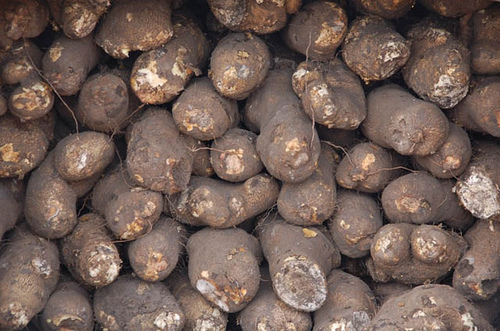
It would interest you to know that as I travelled along the road I saw a lot of nicely arranged yam tubers and cassava at different points. What are they doing there? Waiting for a buyer to come and purchase, or waiting for that old Bedford truck that passes once a day or hoping one of these private land cruisers would come and buy. Seeing trucks and vehicles stuck in the mud at various sections of the road is a very common sight. Even within Accra, some roads are terrible, and rendered unmotorable whenever there is a downpour. The case of the hinterlands is worse; hardly would you see a tarred road. I can vouch that most of our commercial vehicles cannot traverse such roads. The sad thing about this is the fact that the lion's share of what we eat in Ghana comes from such areas.

So do the people in such areas vote? Yes, they have MPs. How do the MPs go there to campaign? In Nissan Patrols and Toyota Land Cruisers, the V8s. And after they win what happens? Something small or nothing. Damn it!

Agriculture
For a country that has around 56% of it's workforce in the agric sector, it is worrying that much care and attention is not given to the sector. There are a lot of programmes aimed at improving food production, like the Afram plains Agriculture Development Project, the various irrigation schemes, the planned free cocoa seedling distribution, etc. Recently the government secured a 70-million dollar facility from the World Bank to support Small and Medium Scale Enterprises in SMEs in the horticulture, roots and timber sub-sector of the economy. I believe these efforts are already yielding some good impacts. Yet, there is much left to be desired. 


Some of these programmes just select a section of farmers and most often, such programmes are not sustained over time. They are often political programmes which are not given thorough planning, they have no sustainability plan. New governments may choose to continue or discontinue such projects. Where is the once famous Presidential Special Initiative on Cassava?. A lot of people went into this project and the very government that promised the purchase of products was nowhere to be found after harvesting. 

As a nation if we are serious about agriculture, a lot can be achieved. Sometimes I strongly share some of the sentiments of the late Dan Lartey, Kofi Wayo and Dr.  Nduom on agriculture. I believe Ghana can produce what we eat. It is indeed true that a lot of food goes waste in the Afram plains due to inability to cart farm produce to the market. There are stories of pineapples and citrus rotting away on farms in the Central Region. Cassava and yams are rotting away in the soil in the Volta Region. Hundreds of tonnes of maize are going waste in the Northern Region. 


The irony of the situation is that people in the urban areas sometimes just don't know of the existence and abundance of food in the hinterlands; but the Ministry of Food and Agriculture (MoFA) knows, yes they do! A story is told of a poultry farmer in Accra who was trying to import maize to feed his fowls; he doesn't know farmers in the North have more than enough maize. And the farmers cannot get their goods to the urban areas for many reasons including inadequate storage facilities, bad roads from farms, high cost of transportation, among others. Sometimes there may be a truck to cart the goods, but it can get stuck on the road for days, with the watermelons you and I eat sitting it, subject to all the weather conditions you can imagine - rain, sunshine, dust... arrrggg! 

Cheating or helping?
So if you meet a trader who hires his own truck, goes to these farmers and offers 13GHC for an almost full sack of yams, what will you call him? A cheat or a helper? If the farmer does not sell it out, it will get rotten over time, he loses the 13GHC. Before you call me a cheat, you must know that I am not a trader. I was only travelling and saw the yams. I bought from three different buyers. One of them, a pregnant woman told me her 9 tubers cost 7GHC. Typical of Ghana market deals, I bargained from 5GHC and we settled on 6. Seconds later I was feeling so bad I went and added 2 more cedis. I realised one of those those yams could sell for about 2GHC back in Accra. (I could have done better, don't you think so?)

These farmers, after toiling hard all year round end up selling their produce at such low prices to the traders who go there to buy and re-sell for you and I in the urban areas. You pay about 0.90GHC (90 pesewas) for three oranges in Accra, right? You know how much the traders buy from farmers in the Central Region? Between 4-10 cedis per hundred oranges, depending on the size! Pineapples? Traders offer about 20 pesewas for each fruit, and resell for between 80 pesewas to 1GHC. These traders are making money! If only the roads were good, some of these farmers could come down and sell to us directly. We buy cheaper, but they earn more, everyone is happy. But we will only have to keep waiting and hoping for this happiness to come until a serious marriage between the agric and transport sectors.

So if I were the president...
I will push for the injection of more capital and expertise in this sector. If you did a small study on the ownership of the biggest farms in Ghana, you will conclude that most of them are owned by people who were able to access some funds or already had money. Are you aware most rich men are diversifying into agriculture?. If the small holder farmers can be helped with inputs like seedlings, farm machinery and other agro products, food production could increase significantly.

The CSIR and other scientific bodies must be adequately resourced to carry out research and come up with more organic ways of improving production through the introduction of new and improved crop varieties.

While we are waiting for their seeds to germinate and grow till harvest, why can't we speed up road construction? Where are all the monies we have taken for road construction? Kick-backs and politically motivated projects!. Until we really care about each other, and our leaders get the roads linking to our farms constructed, food will continue to go rotten, farmers will still continue to be poor, we won't be eating fresh foodstuff and our food expenditure will keep rising.

There is a lot of good work going on, I believe, and whereas I admit that we cannot get to Z in a twinkle of an eye, it is equally true that more can be done, especially if as a nation we the citizens and our leaders stop misplacing our priorities.

Until I come to solicit for your vote in my Range Rover, think of the farmer in the village, stay safe and live a  green life!

Wednesday, July 13, 2011

First Ghana National Science Congress to focus on Water, Sanitation and the Environment

Scuffing around for some green news this afternoon, I found one worth sharing. Ghana is to have its first ever science congress.

Starting August 2, 2011, the congress, under the theme "Water, Sanitation and the Environment, Securing our Future through Science", would be held in three parts.

There will be presentations from the Ghana science and industry community, exhibitions of works of people in the scientific community and an awards ceremony for distinctions in science. 

At an alarming rate of environmental degradation, this is indeed a move that needs a push. If one ponders over the fact that we lose about 70,000 hectares of forest cover annually, we can no longer afford to sit on the fence. 

I hope the congress will not just be another one of those talk shows, but that it comes up with practical solutions and strategies which will be implemented.

Let's all join Prof Ewurama Addy, the Chairperson of the National Planning Committee of the congress, to help Ghana stay green and stay safe.

-Credit: Ghanaweb

Posted via email from dankasa's posterous

Thursday, June 23, 2011

How to Reduce Domestic Waste

Do you know remember what Uncle Atta said when he visited the Upper East Region?  - well that's if you an an "environmental ear" to hear in the first place-. Our President said:

"I have gone round during the last two days, and the sight that has greeted me has been most unwelcome. The sight of polythene bags here, polythene bags there, polythene bags everywhere".
 
And then he added by beginning with his usual cliché,
 
"My brothers and sisters, we have to take care of our environment".

Does it bother you that there is so much waste around. A friend of mine said: Once upon a time in Ghana, if you found a black polythene bag on the ground, which you rarely did, there was a high chance of finding some coins or goodies in it. Nowadays, if you see one, please FLEEEE, because you have a higher chance of picking up human excreta. Now that's not nice.

So what are we sharing today. While closing my last post I promised to share with you how we can reduce domestic waste. So that's just what I will do. Twenty points for us all....

  1. Replace disposable cups and plastics with reusable ones
  2. Replace disposable alkaline batteries with rechargeable batteries
  3. Donate still useful items to charitable groups, you may not be using them, and you will be blessed too!
  4. Maximize the life of electrical appliances by performing regular maintenance
  5. Do you drive? Keep tires inflated, they'll last longer and your car will pollute less
  6. Repair and refinish well-used furniture
  7. Maintain your property, goods, and stuff--they will last  longer
  8. Reuse wrapping paper to re-wrap or line shelves and drawers
  9. Bring a "no garbage" lunch to work or school, using reusable containers, bags, and a thermos
  10. Dry clothing on clothesline instead of using a gas or electric dryer
  11. Buy what you need, use what you buy
  12. Repair durable goods instead of dumping them when they fail
  13. Be water smart; install low-flow plumbing fixtures
  14. Make note pads out of print overruns, computer printouts, outdated forms and stationery
  15. Print and copy on both sides of the paper
  16. Buy the large size of items you use often
  17. Going to shop? Take a re-usable bag
  18. Turn your computer monitor off when leaving for more than an hour
  19. Look for durability in products you buy and use, not just lower price
  20. Pass this list on to someone else!!!!

He who has an environmental ear, let him hear what My Green Piece of Mind shares! Ciao

Posted via email from dankasa's posterous